
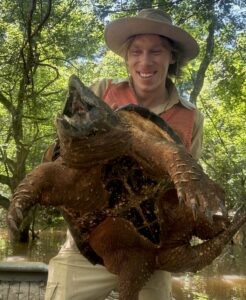
Myself with an alligator snapping turtle

A Mississippi sandhill crane guarding her nest
Three years ago, I served my first term with ACE and the Bureau of Land Management in El Centro, California, in the role of Lizard Demographics Survey Member. In this role, I monitored the spatial ecology of near-threatened lizards in the heart of the desert. I walked transect surveys beneath the blazing sun, performed morphological assessments, and navigated to remote field sites. I thrived in this environment, despite the stark contrast of Californian summers from my native Maine. It was through ACE, there in the barren sands of El Centro, that I began to find my footing in the field of wildlife biology. I enjoyed my time with the program so much that I leapt at the chance to reapply. For the past year, I’ve been serving with ACE, in partnership with the U.S. Fish and Wildlife Service (USFWS), in the role of Biological Support Member in the Southeast, contributing to regional efforts to monitor sensitive species.

Spanish moss dangling from live oaks.
This role has provided me with a plethora of experiences within the National Wildlife Refuge system. I wrangled 80-pound alligator snapping turtles out of Louisiana bayous during mark-recapture surveys. I dynamited beaver dams in Arkansas to promote the cypress growth. I received rocket-netting training in Tennessee to use explosives to capture waterfowl. In Mississippi, I was provided the opportunity to work with two critically-endangered species; I released dusky gopher frogs into the wild and performed nest checks for Mississippi sandhill cranes. Growing up, I never imagined myself running beach patrols in Alabama for sea turtles, yet that’s how I spent my last summer. I was present for two loggerhead hatchings! Most notably, this role enabled me to propose, design, and conduct a herpetofaunal inventory at Big Branch Marsh National Wildlife Refuge. I detected 47 reptile and amphibian species on refuge by utilizing visual encounter surveys, aquatic traps, and drift fence camera traps. This total included four state-listed species and three species never detected by previous inventories.

Dynamiting a beaver dam

Wood ducks captured for banding
During my time in the Southeast, I met so many amazing people and had the opportunity to network with some incredible ACE interns. I’m beyond grateful to ACE and the USFWS for providing me with these experiences. It’s been the greatest pleasure to support our nation’s public lands and contribute to the conservation of so many listed and endemic species. Next week, I’m moving to the Florida Keys for my first federal role as a Wildlife Biological Science Technician with the USFWS; this ACE role was a fundamental step on my journey there.

A broad-banded watersnake and Western ribbonsnake