
Scaling Conservation Impact: How National Organizations Support Local Needs
Across the country, the work of protecting public lands happens at a local level, on individual trails, within specific habitats, and across distinct communities. Yet the challenges facing these places are increasingly national in scale. Rising visitation, deferred maintenance, ecosystem pressures, and workforce gaps require solutions that extend beyond any single park, refuge, or forest.
Meeting these needs requires a coordinated approach - one that connects national capacity with local priorities.
For more than two decades, American Conservation Experience (ACE) has operated within this space, supporting conservation efforts at over 2,000 project sites. By combining regional field hubs with a distributed staff structure, ACE has built a model that scales impact while remaining responsive to the unique needs of each landscape and partner. This operational structure also ensures that ACE is advancing the professional development skills of its program participants.
Local Challenges, National Scale
Every public land site operates within its own context. A national park in the West may face trail erosion and wildfire impacts, while a wildlife refuge in the Southeast may focus on habitat restoration and invasive species management. Despite these differences, many sites share common challenges:
- Limited staffing capacity
- Increasing visitation and infrastructure demands
- Long-term ecosystem restoration needs
- A growing need for skilled conservation professionals
Addressing these issues requires both site-specific solutions and scalable support systems.
“Conservation is inherently local, but the challenges we’re addressing are national in scope,” said Jenn Layman, ACE Chief Partnership & Strategy Officer. “What’s needed is an approach that respects the uniqueness of each place while providing the workforce, infrastructure, and consistency required to support many landscapes at once.”
A Hub-and-Spoke Model for National Impact
ACE’s ability to operate at scale is grounded in a hub-and-spoke model that combines regional field operations with national coordination.
ACE Conservation Crews are deployed from key hub locations, including:
- Flagstaff, Arizona
- Hurricane, Utah
- Asheville, North Carolina
- Sacramento, California
- Ridgecrest, California
- Coachella Valley, California
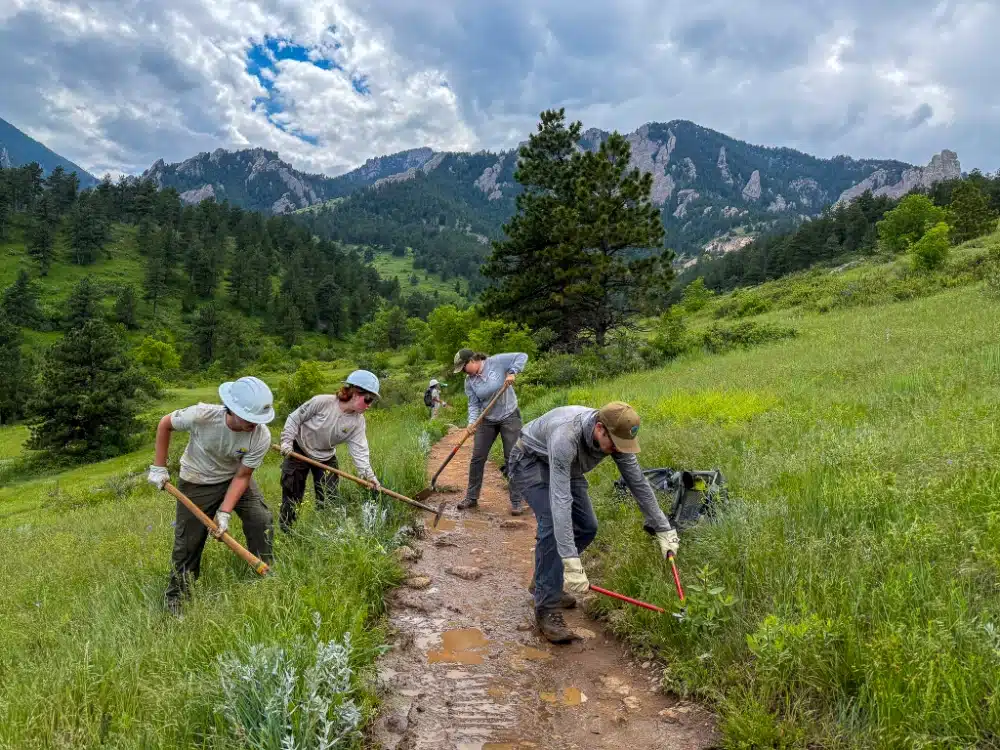
From these hubs, crews mobilize to project sites across surrounding regions - working in national parks, forests, wildlife refuges, and other public lands. ACE deploys its specialized ‘Solutions’ team to lead trainings in the field benefiting program participants and ACE staff.
Complementing this field presence is a distributed network of remote staff who provide program management, partnership coordination, logistical support, and member development across the country. This structure enables ACE to operate nationally without losing the responsiveness and adaptability required at the local level.
“Our structure is intentionally designed to connect local implementation with national resources,” said George Grygar, ACE Chief Program Officer. “Regional crews bring consistency and field expertise, while our remaining staff ensure that partners receive the support and coordination needed to move projects forward.”
Strengthening Local Capacity Through Partnership
A defining feature of scalable conservation is partnership. Federal agencies, such as the National Park Service, Bureau of Land Management, U.S. Forest Service, and U.S. Fish and Wildlife Service, manage diverse landscapes, each with unique operational priorities.
ACE supports these partners by:
- Expanding workforce capacity for priority projects
- Providing trained crews equipped for remote and challenging environments
- Placing emerging professionals in specialized, mentorship-driven roles
- Offering flexible support that aligns with site-specific goals
This model is designed to be responsive and aligned with the priorities identified by land managers on the ground.
“When you’re working across multiple sites, consistency matters but so does flexibility,” Layman added. “Our ability to adapt to local needs while maintaining strong operational and safety standards is what allows us to be an effective partner at scale.”
From Projects to Systems Thinking
While conservation field work still relies on many manual tools, it also requires strong systems, data management, and communications to make projects possible.
ACE’s model supports this by:
- Standardizing training, safety, and operational practices across regions
- Creating efficiencies through centralized coordination and logistics
- Maintaining continuity of work across seasons and geographies
- Building long-term relationships with partners
- Developing its own technology including apps for operational efficiency
As part of its overall coordination strategy, ACE developed its own internal applications that help manage key functions, including member timesheet tracking, partner invoicing, and program logistics.
Investing in People as Much as Places
At the center of scalable conservation is people. The long-term success of public lands depends not only on the work being done today, but on the individuals who will carry that work forward.
ACE’s model integrates hands-on field experience with workforce development in both its crew program and its Emerging Professionals in Conservation (EPIC) program. Through EPIC, ACE places early-career professionals within land management agencies, which helps build a pipeline of skilled individuals prepared to support public lands.
“Lasting impact comes from investing in both the land and the people who care for it,” Layman said. “By developing the next generation of conservation professionals while supporting on-the-groundwork, we’re helping ensure these efforts continue well into the future.”
A Model for the Future of Conservation
ACE’s work across the country demonstrates how a hub-based field model, supported by a distributed national team, can effectively connect local needs with national resources.
Scaling conservation is much more than just increasing the number of projects, but ensuring that public lands have the support, capacity, and partnership it needs to thrive.