

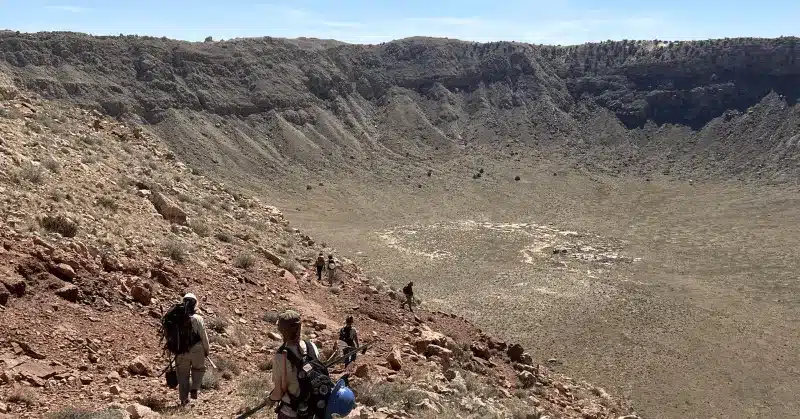
Few places on Earth capture the imagination quite like Meteor Crater. Located near Winslow, Arizona, this world-famous geological landmark draws visitors from around the globe to experience the site of a meteor impact that occurred approximately 50,000 years ago. While the crater itself is a destination of scientific significance, safely accessing and exploring this remarkable landscape requires thoughtful stewardship and sustainable infrastructure.
In spring 2026, an American Conservation Experience (ACE) crew partnered with The Barringer Crater Company to improve visitor access by constructing a new trail reroute inside the crater. Over the course of 16 workdays, the crew completed a challenging hand-built trail project designed to make a steep section of the route safer, more sustainable, and easier to navigate for hikers traveling to the crater floor.
Addressing a Challenging Trail Section
The existing trail included a steep segment that descended directly down loose, rocky terrain. Not only did this create difficult hiking conditions for visitors, but it also contributed to ongoing erosion issues. Because the trail followed a straight path down the slope, rainwater naturally flowed along the route, accelerating wear and making maintenance increasingly difficult.
Recognizing these challenges, ACE and The Barringer Crater Company developed a plan to reroute the trail through a more sustainable alignment. Rather than continuing directly downhill, the new route incorporates switchbacks and carefully constructed stone features that better manage water flow while providing a safer and more enjoyable hiking experience.
The result is a trail built not only for today's visitors, but for future generations of adventurers seeking to experience this extraordinary landscape.
Crafting a Sustainable Solution by Hand
Trail construction inside Meteor Crater presented unique challenges. The steep terrain, loose rock, high winds, and exposed conditions required significant planning, physical effort, and technical expertise. Rather than relying on heavy machinery, the ACE crew completed the work largely by hand, carefully shaping the trail corridor and building durable stone infrastructure throughout the reroute.
By sourcing stone directly from the surrounding area, the crew created trail features that blend naturally into the landscape while providing long-term stability. Large rocks were drilled, shaped, split, and positioned to form staircases and retaining walls capable of withstanding years of use and exposure. The team also tied many stair structures into existing bedrock and large stable rock formations, helping ensure the durability and longevity of the finished trail.
These techniques represent some of the most effective practices in sustainable trail construction, reducing erosion while improving visitor safety and accessibility.

Measurable Impact
The project's accomplishments reflect both the scale of the work and the dedication of the crew.
During the project, ACE members:
- Constructed 178.15 feet of new hand-built trail
- Set 493 cubic feet of rock
- Installed 24 stone steps
- Contributed 950 hours of service over 16 workdays
While those numbers are impressive, they only tell part of the story. Every rock step, retaining wall, and section of trail tread required careful craftsmanship and teamwork under demanding conditions.
The completed reroute now provides a more stable and intuitive path through one of the trail's most difficult sections, improving the experience for visitors while protecting the surrounding environment from future erosion.
Preserving Access Through Stewardship
Projects like this highlight the critical role conservation crews play in maintaining access to some of America's most remarkable places. Sustainable trails do more than guide visitors through a landscape—they protect sensitive resources, reduce maintenance needs, and help ensure public access can continue responsibly for years to come.
At Meteor Crater, the ACE crew's efforts transformed a problematic section of trail into a durable and resilient route that better serves both visitors and the landscape itself. Through hard work, technical trail-building skills, and a commitment to conservation, the team helped preserve access to one of Arizona's most iconic destinations.
As thousands of visitors continue to descend into Meteor Crater in the years ahead, they'll benefit from a trail built with sustainability, safety, and stewardship at its core—a lasting legacy of service and conservation in one of the world's most extraordinary natural landmarks.
Before and After Set:
Rock steps were set in narrow and steep section. Rocks were sourced right from stone found in and around the trail and cut down to size.
